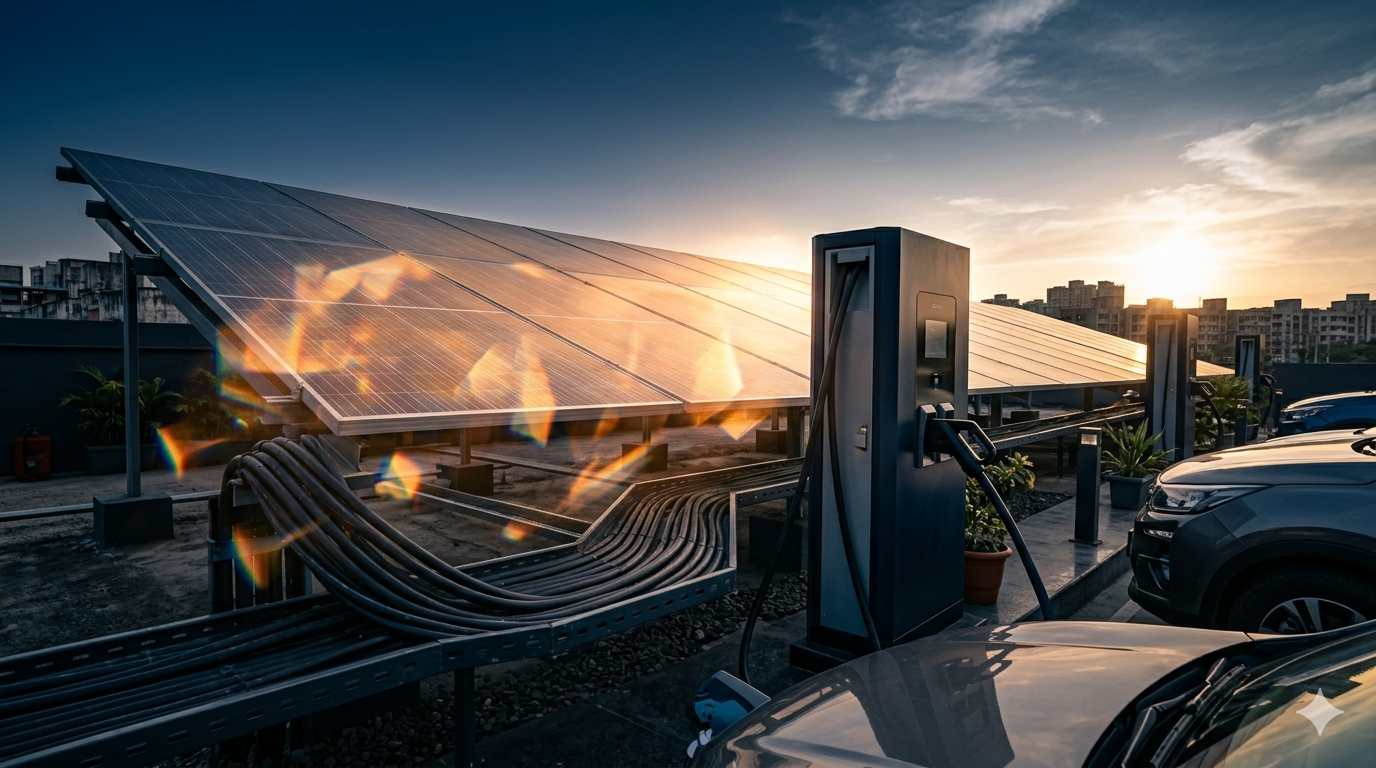
The Two-Conversion Problem
In a standard AC-coupled solar EV charging setup, energy undergoes two power conversions: the solar panel's DC output is inverted to AC by the string inverter, then rectified back to DC by the charger's internal power electronics. Each conversion stage carries a 3–6% efficiency loss. For a 100 kW solar array running 5 peak hours per day, those two-stage losses amount to roughly 4,000–8,000 kWh per year — energy that was generated but never reached a vehicle battery.
DC coupling — connecting the solar array directly to a shared DC bus with the BESS and a DC-DC converter feeding the charger — eliminates one of those conversion stages. The theoretical efficiency improvement is well-documented in power electronics literature, with end-to-end DC-coupled system efficiencies of 92–95% reported in research contexts, versus 80–85% for equivalent AC-coupled systems.
The Engineering Challenges
The efficiency gains of DC coupling do not come free. The additional complexity is real and should be understood by any operator considering this architecture:
- DC bus voltage management: A shared DC bus requires active voltage regulation across all sources and loads — solar MPPT, battery charge/discharge, and vehicle charging — simultaneously. During cloud transients or sudden vehicle plug-in events, the bus controller must respond in milliseconds to maintain stability.
- Protection coordination: DC fault currents are more dangerous than AC equivalents because there is no natural zero-crossing to interrupt arcs. DC circuit breakers rated for the bus fault level are significantly more expensive than AC equivalents.
- Certification complexity: AC-coupled solar systems benefit from well-established BIS and CEA certification pathways. DC microgrid architecture is newer territory for Indian regulatory bodies, and certification timelines can be longer.
DC coupling is most compelling at sites with high solar-to-charging energy ratios — where a significant fraction of EV charging energy will come directly from solar rather than the grid. At sites where grid energy dominates, the efficiency improvement may not justify the additional system complexity and cost.
Where EVBooth Is Heading with This
The Hybrid Loop platform we are preparing to launch incorporates DC coupling as an option for high-solar sites, specifically for our five sites currently under negotiation. Our engineering team has been working through the bus controller design, protection coordination, and CEA compliance requirements over the past year. We are not yet at the stage of reporting measured efficiency data from live deployments — but we will publish those numbers transparently once our first Hybrid Loop sites are commissioned. The architecture is sound; the proof will be in the field data.