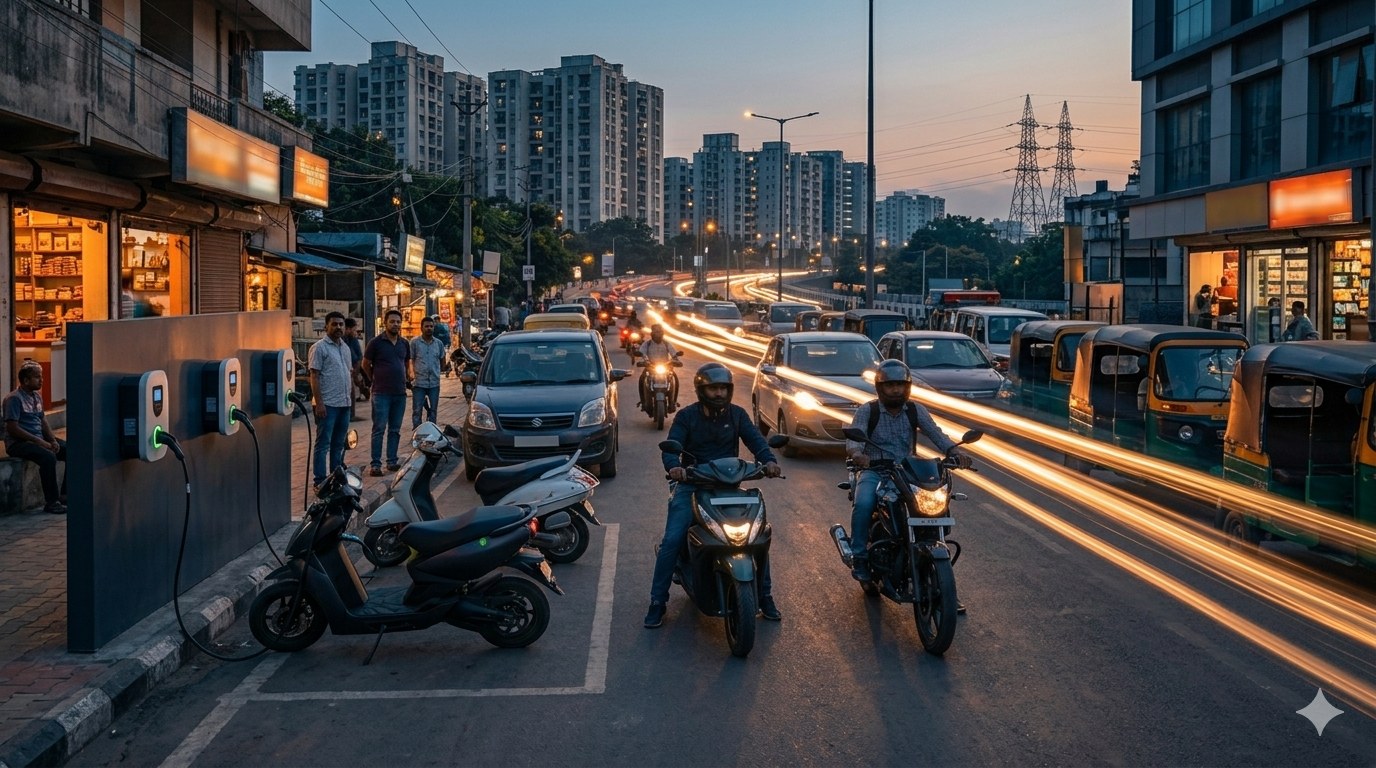
The Market Is Dominated by Two-Wheelers
India registers approximately 15–17 million two-wheelers annually — more than any other country. EV penetration in the two-wheeler segment crossed 6% in FY2024 and is growing at 30–40% year-on-year, driven by falling battery prices, FAME II subsidies, and genuine total-cost-of-ownership advantages for high-utilisation users. Society of Indian Automobile Manufacturers (SIAM) data shows two-wheelers accounting for roughly 70% of all EV registrations in India. Any EV charging infrastructure strategy that is primarily designed around four-wheelers is missing the dominant volume category.
Why Two-Wheeler Charging Is Different
The charging infrastructure requirements for two-wheelers differ from four-wheelers in ways that matter for both hardware selection and site planning:
- Power level: Most two-wheeler OBCs are 600W–1.5 kW — far below the 7.4 kW Type 2 AC chargers that dominate four-wheeler infrastructure thinking. A standard 3 kWh two-wheeler battery charges fully in 2–4 hours on a simple 5A socket.
- Home charging dominance: The majority of two-wheeler EV owners charge at home, on a standard 5A household socket. The charging infrastructure gap is not at workplaces or public stations — it is in apartment buildings where residents lack individual sockets in parking areas.
- Load density: An apartment building with 200 residents, each with an EV two-wheeler, could face 200 simultaneous 800W charging loads if all park and plug in at the same time — a 160 kW addition to the building's common area load that the electrical infrastructure was never designed for.
The right infrastructure for two-wheeler charging in apartment buildings is not one high-power charger — it is 20–30 managed low-power sockets with load management software that ensures the building's total electrical draw never exceeds the common area sanctioned supply, regardless of how many vehicles are connected simultaneously.
What EVBooth Offers for the Two-Wheeler Segment
Our AC charger hardware supports Bharat AC-001 socket configurations alongside Type 2, making our managed charging clusters suitable for mixed two-wheeler and four-wheeler parking environments. The load management logic in our EMS handles high-density low-power scenarios — allocating available capacity across many connected vehicles by priority and departure time — as well as the high-power depot scenarios our platform is also designed for. If you are managing an apartment society, commercial complex, or workplace with a growing two-wheeler EV fleet, we are glad to assess the right configuration for your specific electrical constraints.