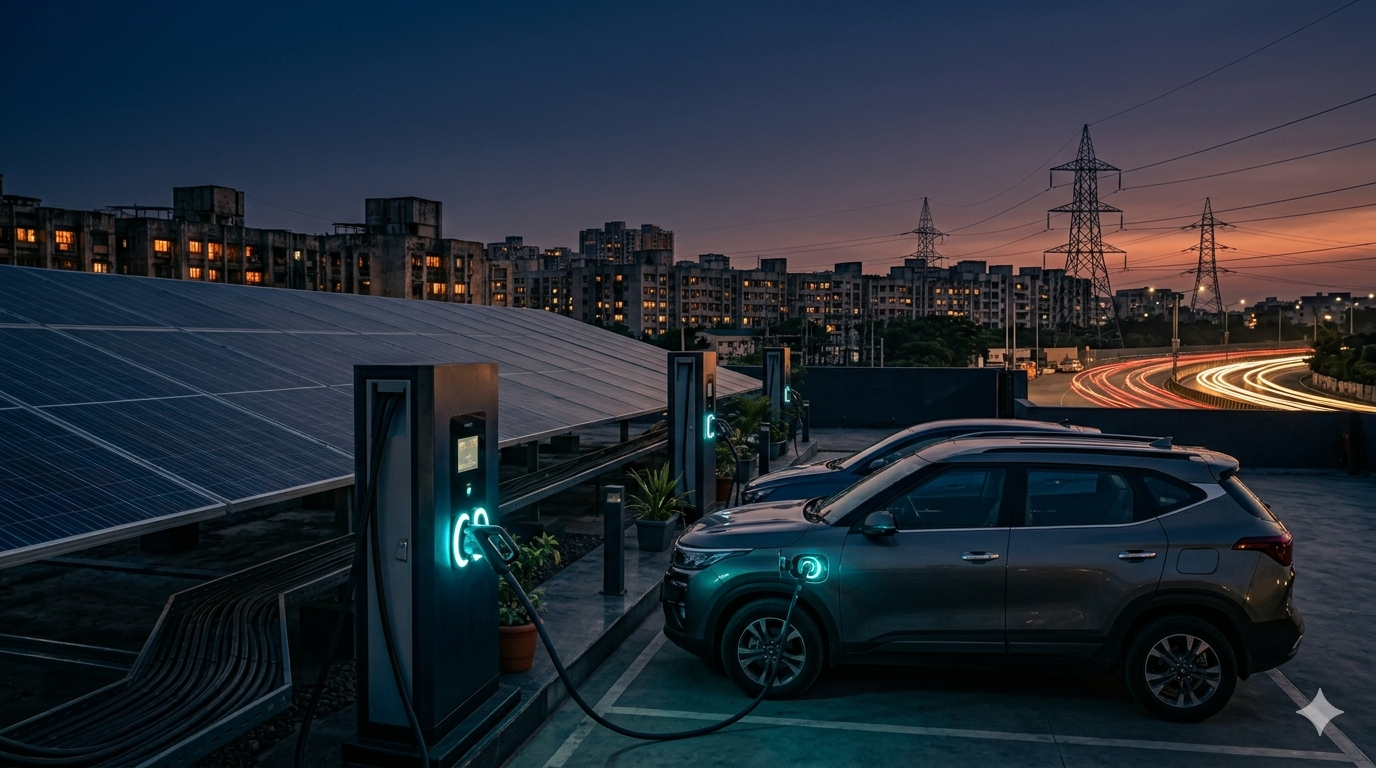
What V2G Promises — and Why It Matters for India
Vehicle-to-Grid (V2G) uses a bidirectional charger to push energy from an EV battery back into the grid during peak demand periods, then recharge the battery from cheap off-peak or solar energy. The value proposition is significant: India's grid faces a 4–8 hour mismatch between peak solar generation (11 am–2 pm) and peak electricity demand (6–10 pm). A large fleet of V2G-enabled EVs could bridge this gap, reducing the need for expensive gas peaking plants while earning their owners a grid service payment.
India has roughly 1.5 million three-wheelers and growing EV two-wheeler fleets that sit parked for large portions of the day. If even a fraction of these were connected to bidirectional chargers during their idle hours, the aggregate dispatchable storage capacity would be significant — TERI estimates suggest 10 GWh of potential V2G capacity from commercial EVs alone by 2030.
What the Technology Requires
V2G requires three things to work together: a bidirectional charger (capable of both charging and discharging), a vehicle with a compatible bidirectional onboard charger, and a communication protocol linking charger, vehicle, and grid operator. ISO 15118-20 is the standard that handles the charger-to-vehicle V2G communication layer; OCPP 2.0.1 handles the charger-to-CSMS layer. Both standards are mature and commercially available — the hardware exists today from several global manufacturers.
- Bidirectional charger availability: Several manufacturers — including Delta, ABB, and domestic players — have commercially available bidirectional AC chargers in the 7–22 kW range. BIS certification for bidirectional units in India is still in progress for most models.
- Compatible vehicles: The Nissan Leaf (CHAdeMO V2G) has supported V2G since 2013. Among Indian market vehicles, V2G-capable onboard chargers are rare — most current models have unidirectional OBCs. This is the primary near-term constraint.
- Grid operator participation: CERC's 2024 Ancillary Services amendment permits EV aggregators to bid into reserves markets. State DISCOM implementation is still patchy.
V2G's commercial timeline in India is primarily a vehicle OEM question, not a charger question. As domestic manufacturers move to larger onboard chargers for faster AC charging, the incremental cost of making them bidirectional is modest — and some OEMs have signalled this in their product roadmaps for 2026–27.
How EVBooth Is Preparing
EVBooth's CSMS platform and EMS are being designed from the outset to support bidirectional dispatch — so that when V2G-capable vehicles reach meaningful volumes in India, our network will be ready to orchestrate them without a platform rebuild. The Hybrid Loop sites we are negotiating will include bidirectional charger infrastructure as a future-proofing element, even if active V2G dispatch is not the day-one use case. Building the capability before the market demands it is the right posture for operators who want to be relevant when it arrives.