How Far Costs Have Fallen
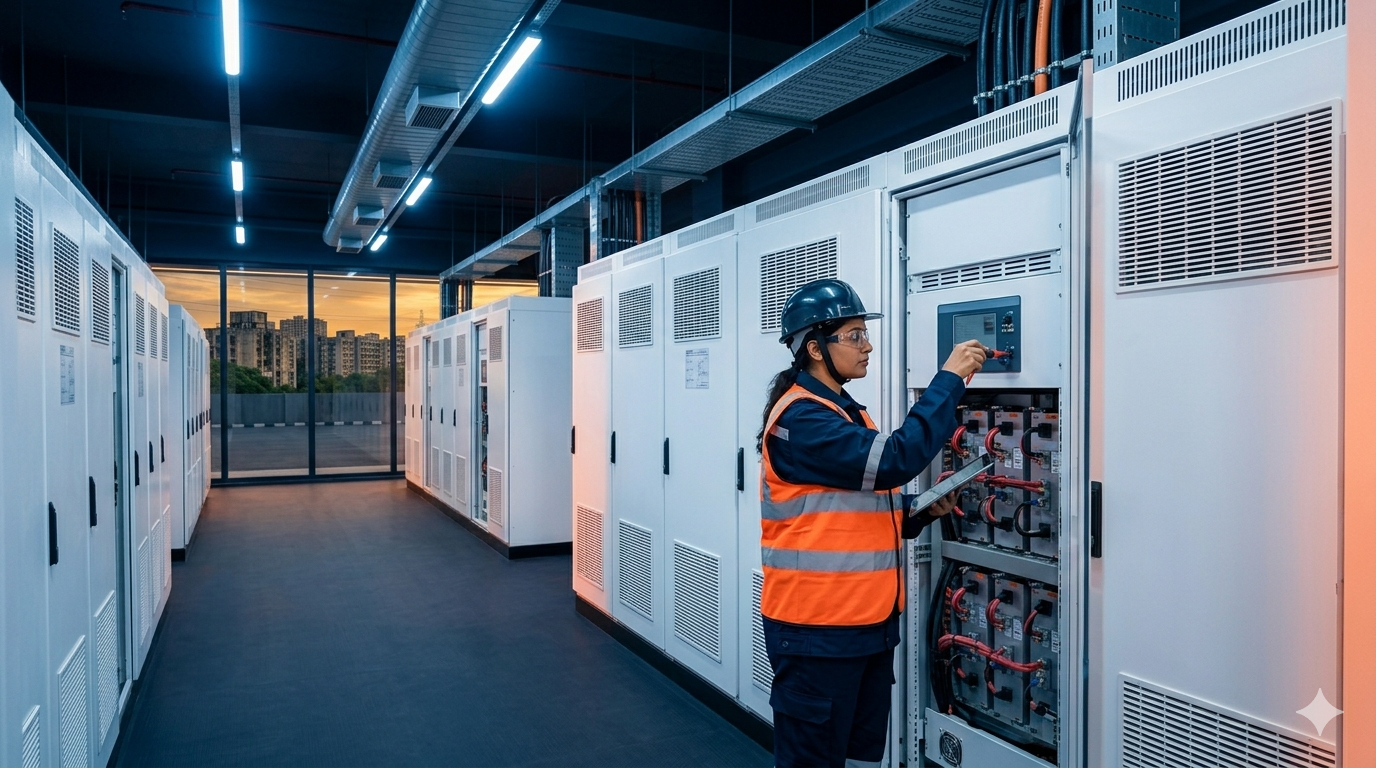
Bloomberg NEF's 2024 Battery Price Survey pegged utility-scale lithium-ion battery pack prices at $149/kWh — down from approximately $780/kWh in 2013. That is an 81% decline in eleven years. For commercial and behind-the-meter applications (which carry a premium over utility-scale pricing), current procurement prices in India for containerised LFP BESS systems with BMS and thermal management range from ₹6,000–8,500/kWh depending on system size and supplier — substantially lower than the ₹18,000–22,000/kWh that characterised the market in 2018.
Two threshold crossings have been particularly significant. At roughly $200/kWh (crossed around 2020), distributed storage became cheaper than new peaking gas plant capacity on a levelised cost basis. At roughly $100/kWh (approached in 2024 for utility scale), storage became cheaper than upgrading distribution infrastructure to handle new loads. EV charging operators are now on the right side of both thresholds.
Why LFP Chemistry Won the Stationary Storage Market
Lithium Iron Phosphate (LFP) has become the dominant chemistry for stationary storage for reasons that are particularly relevant to Indian deployment conditions:
- Cycle life: LFP delivers 4,000–6,000 cycles at 80% depth of discharge — roughly 12–16 years of daily cycling — compared to 1,500–2,500 cycles for NMC. This makes it dramatically cheaper on a cost-per-cycle basis.
- Thermal stability: LFP's olivine crystal structure does not undergo the thermal runaway that has caused high-profile NMC fires. In Indian ambient temperatures of 35–45°C, this is not a theoretical benefit — it is a practical safety requirement.
- No cobalt dependency: LFP eliminates reliance on cobalt supply chains centred in the DRC, reducing both price volatility risk and ESG exposure.
At current LFP pricing, the financial case for co-locating a 100 kWh BESS with a new EV charging hub is clear for any site with a commercial electricity tariff above ₹7/kWh and predictable overnight charging demand. The BESS pays for itself through demand charge avoidance and off-peak energy arbitrage — the solar charging capability is an additional benefit, not the primary justification.
What Comes Next: Sodium-Ion on the Horizon
Sodium-ion batteries — which replace lithium with abundantly available sodium — are entering commercial production from Chinese manufacturers including CATL and BYD. Current sodium-ion cell costs are slightly above LFP, but the technology roadmap projects costs below $80/kWh by 2027. For stationary storage where energy density is less critical than cycle life and cost, sodium-ion may begin to displace LFP in new projects by the late 2020s. EVBooth's battery management software is designed to be chemistry-agnostic, supporting any future cell technology without requiring a hardware platform change.