Range Anxiety on Indian Highways Is a Real Barrier
India has approximately 1,46,000 km of national highways, but as of early 2025, public DC fast chargers are concentrated almost entirely in metro and Tier-1 urban areas. For an EV driver attempting the Bengaluru–Chennai or Delhi–Jaipur run in a mid-range passenger EV with a real-world range of 180–220 km, the anxiety is rational: missing a working fast charger mid-journey means a genuinely stranded vehicle, not a mild inconvenience. NITI Aayog's 2023 EV charging infrastructure report identified highway corridor gaps as one of the top three barriers to EV adoption in India.
The standard recommendation — space chargers no more than 60 km apart on major corridors — would require roughly 120 new highway charging sites on the Golden Quadrilateral alone. That is a significant deployment challenge, but the business case at well-trafficked highway locations is genuinely strong: dwell-time commercial models (food, fuel, rest), high average session energy (long-distance drivers arrive with deeply depleted batteries), and captive audiences with a strong motivation to pay for reliable fast charging.
Why Solar-BESS Is the Right Architecture for Highway Hubs
Highway locations have two characteristics that make solar-BESS integration particularly compelling. First, many highway sites have limited grid infrastructure — connecting to an HT line for a 250 kW highway hub can take 18–24 months and cost ₹40–80 lakhs in transformer and cabling works. A properly sized solar-BESS system can operate with a smaller grid connection — or even off-grid for limited periods — reducing connection costs and timeline significantly.
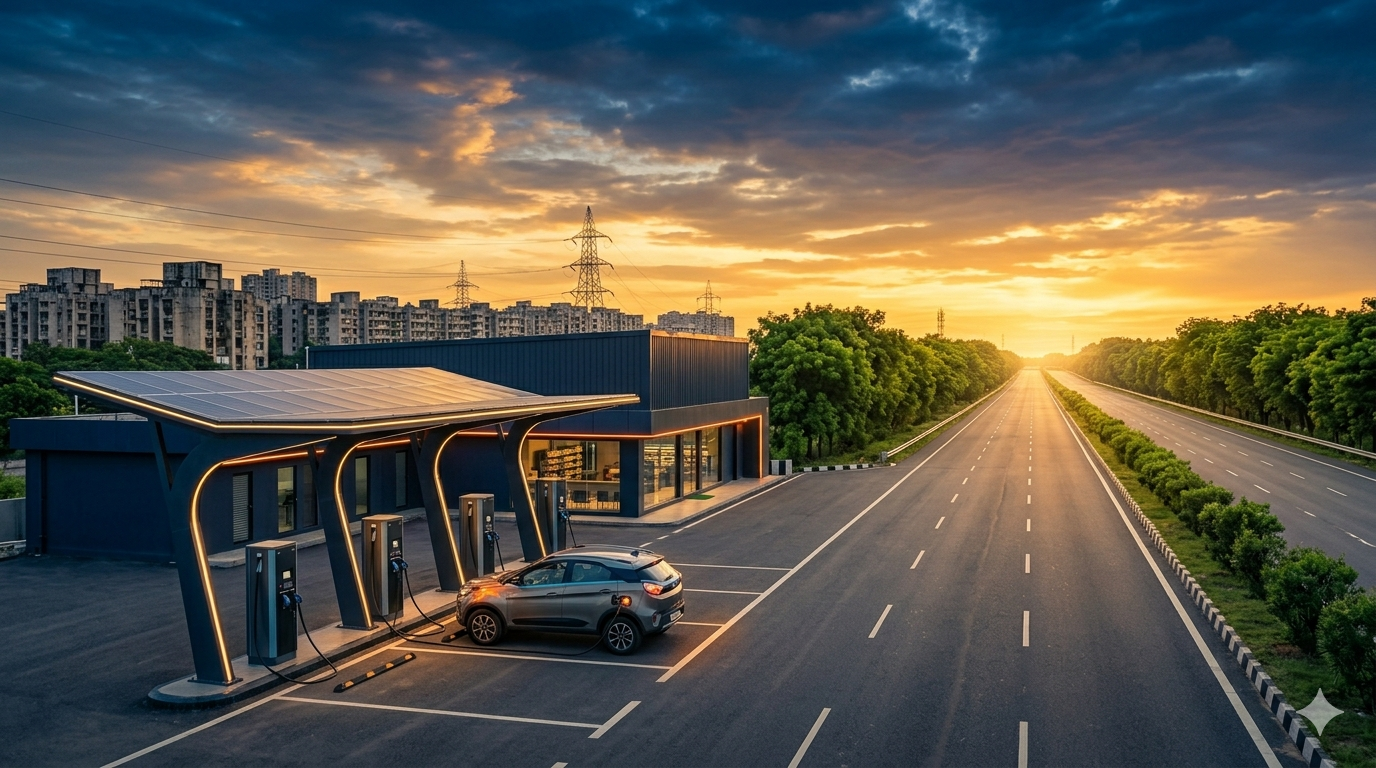
Second, highway locations typically have good solar resource (open land, minimal shading) and predictable traffic patterns that allow the EMS to forecast demand and pre-position stored energy. A 100 kW solar canopy combined with 200 kWh of BESS can provide meaningful energy independence for a 2-charger (60 kW + 120 kW) highway hub during daylight hours.
The economics of highway charging hubs are compelling at utilisation rates above 15–20% of rated charger capacity — which major corridors like Delhi–Jaipur and Bengaluru–Chennai are already approaching at well-located sites, and which growth trajectories suggest most Golden Quadrilateral corridors will reach by 2027.
EVBooth's Hybrid Loop Highway Ambition
Highway corridor deployment is a core part of our Hybrid Loop roadmap. Among the five sites we are currently negotiating for the Hybrid Loop launch, at least two are highway-adjacent locations specifically chosen to demonstrate the solar-BESS-charging integration in a corridor context. We are not at the stage of announcing specific locations, but we expect to be able to share details in the coming months. If you operate a highway-adjacent property — fuel station, dhaba, hotel, or logistics yard — and are interested in hosting a Hybrid Loop site, we would be glad to hear from you.