The Multi-Standard Reality
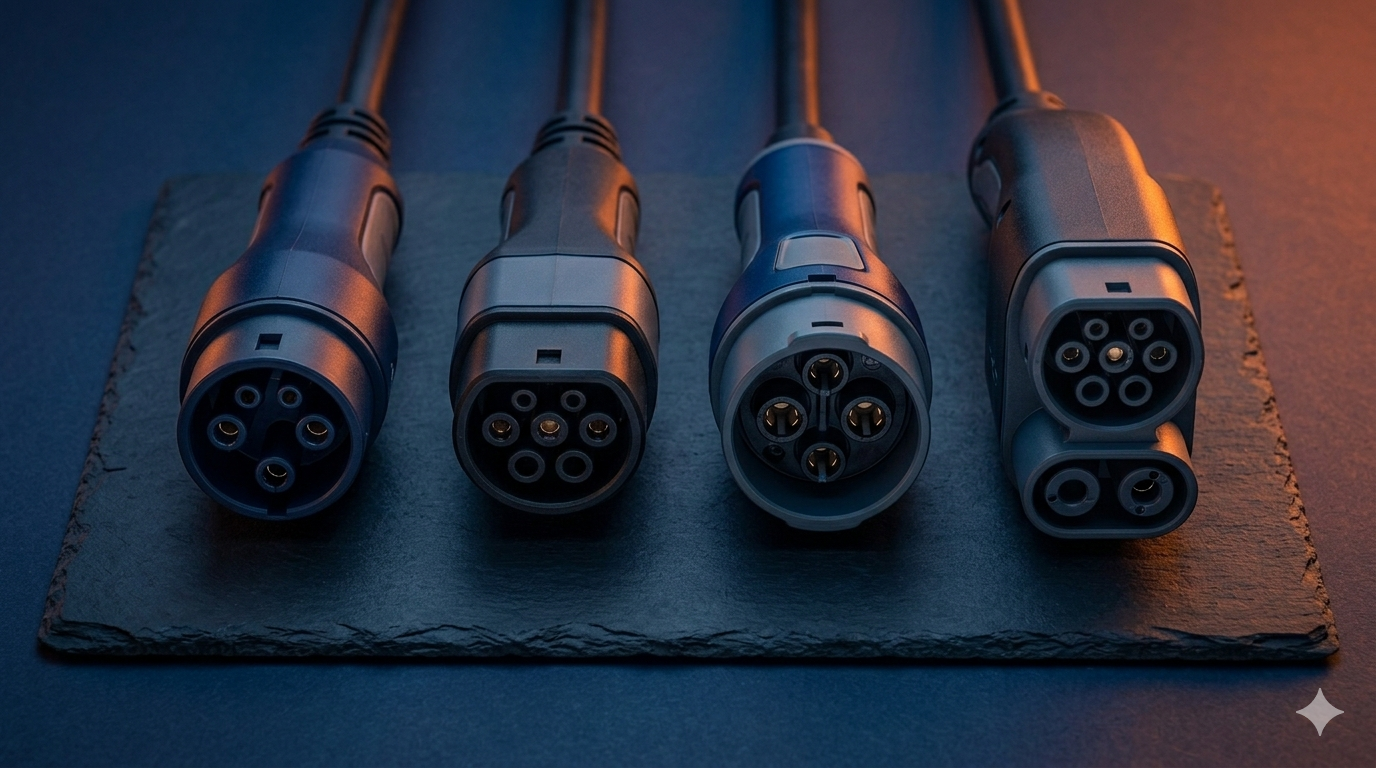
Unlike Europe, which has largely standardised on Type 2 AC and CCS2 DC, or China, which uses GB/T, India's EV charging connector landscape is genuinely fragmented. The Bureau of Indian Standards has mandated Bharat AC-001 for AC charging and CCS2 for DC fast charging — but a large proportion of two-wheelers and three-wheelers in the market use a proprietary 5-pin connector inherited from early entrants, while some imported vehicles require Type 2 AC and CHAdeMO. A public charging operator who wants to serve every EV on Indian roads today needs to support at least four connector types.
What Each Standard Actually Delivers
- Bharat AC-001: A BIS-mandated 5-pin AC connector supporting single-phase charging at up to 15A (3.3 kW). Mandatory on all new EV models sold in India from January 2022. Predominantly found on two-wheelers and light three-wheelers. Full charge time for a typical 3 kWh two-wheeler battery: 60–90 minutes.
- Type 2 AC (IEC 62196-2): The global standard for higher-power AC charging, supporting 7.4 kW (single-phase) to 22 kW (three-phase). Used on most passenger four-wheelers and the higher-end two-wheeler and three-wheeler segment. EVBooth's AC charger range is Type 2 based with Bharat AC-001 adaptor socket options.
- CCS2 (Bharat DC-001 / IEC 62196-3): Combined AC and DC connector supporting up to 350 kW DC. The BIS-mandated standard for DC fast charging in India and the global standard for passenger cars. All four-wheelers sold in India should use this connector.
- CHAdeMO: Japanese DC standard still found on some Nissan, Mitsubishi, and older Kia models. Market share is declining and will continue to do so — but a public highway hub that wants to serve all vehicles needs at least one CHAdeMO outlet through the transition period.
A pragmatic hub configuration for a public location in 2025: one 120 kW DC charger with CCS2 + CHAdeMO outputs, two 7.4 kW Type 2 AC chargers, and two Bharat AC-001 sockets. This covers every EV currently on Indian roads from a single installation without over-investing in connector diversity that will consolidate over the next 3–5 years.
The Path to Simplification
The connector landscape will consolidate, and faster than most operators expect. CCS2 is winning globally; CHAdeMO production is winding down. Among two-wheelers and three-wheelers, the transition to higher-power onboard chargers — driven by consumer demand for faster home charging — will push the market toward Type 2 AC and away from the legacy 5-pin connector. By 2028, a two-connector deployment (CCS2 DC + Type 2 AC) should serve 90%+ of EVs on Indian roads. Operators who install flexible multi-outlet hardware today will be well-positioned for that consolidation without requiring hardware replacement.