The Problem Solar Alone Cannot Solve
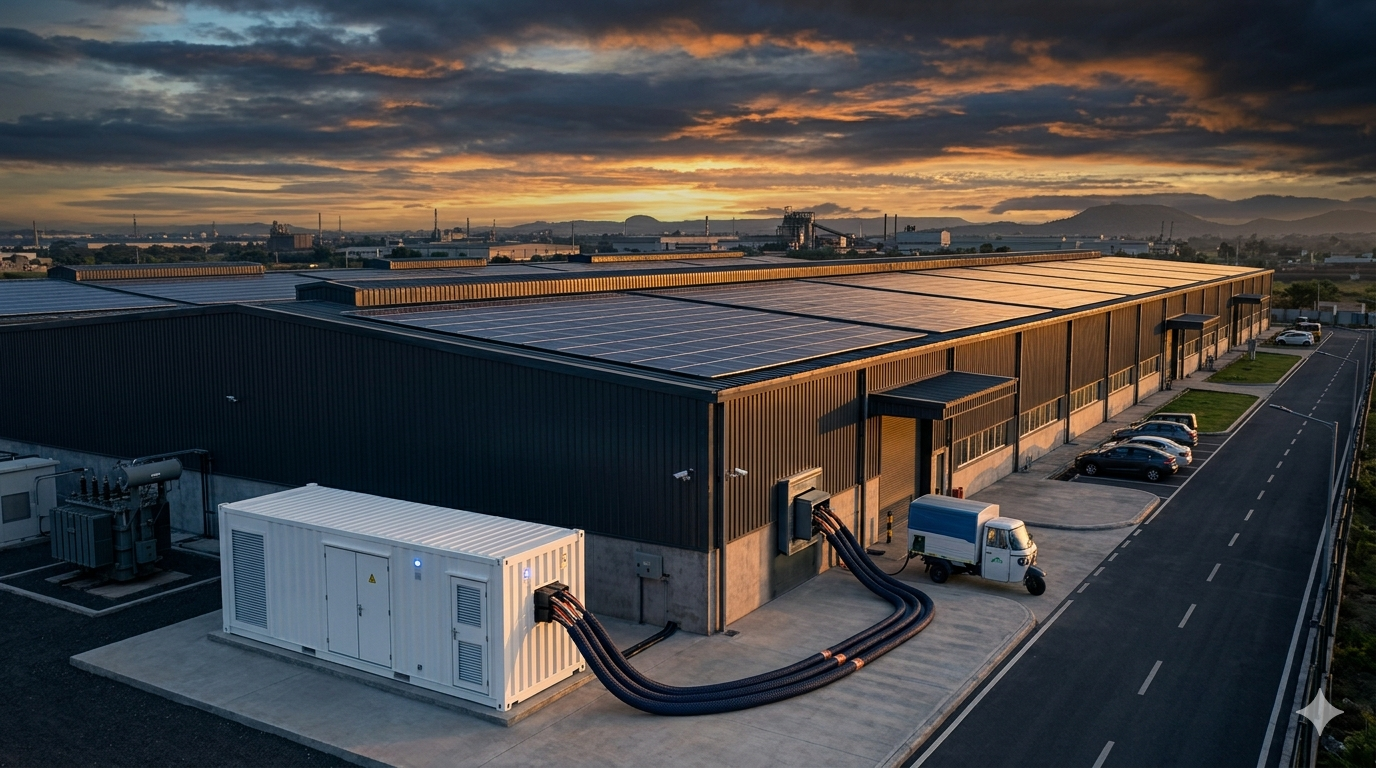
A 500 kW rooftop solar installation on an industrial facility in Coimbatore generates roughly 2,200–2,500 kWh on a good day — but almost none of it between 6 pm and 6 am, precisely when grid demand charges are highest and grid reliability is lowest. Without storage, a solar-only installation still requires full grid dependence for evening and night operations, and the demand charge structure means the highest-cost electricity consumption often cannot be avoided.
This is the gap that BESS fills. A co-located 500 kWh LFP battery stores surplus midday solar generation and dispatches it during the 6–10 pm peak, reducing grid draw precisely when it is most expensive. For facilities with significant demand charges — where the peak 15-minute draw in any month determines a charge applied to the entire month's billing — even modest peak shaving can deliver significant savings.
The Industrial Case: Peak Shaving and Demand Charge Reduction
Demand charges in India's HT commercial tariffs typically run ₹200–400/kVA/month of recorded maximum demand. For a facility with a sanctioned 1 MVA supply drawing regular peaks of 1.2 MVA, the penalty for the 200 kVA overage runs ₹40,000–80,000/month — ₹5–10 lakhs/year — for what might be a handful of daily peak events. A BESS configured to monitor instantaneous load and discharge when demand approaches the sanctioned limit can eliminate this overage entirely, paying for a significant portion of its capital cost through demand charge savings alone.
- Data centres and precision manufacturing: These facilities cannot tolerate even brief power interruptions. A BESS with sub-millisecond switchover time provides seamless backup during grid outages — unlike diesel generators, which typically require 8–15 seconds to start and stabilise.
- Food processing and cold chain: Facilities where a power interruption causes direct product loss benefit from BESS backup as a direct risk mitigation.
- Export-oriented manufacturers: EU Carbon Border Adjustment Mechanism requirements coming into effect in 2026 create a financial incentive to reduce scope 2 emissions — which solar-plus-storage directly addresses.
At current LFP BESS pricing of ₹6,000–8,500/kWh installed, the financial case for industrial BESS is most compelling at facilities where demand charge avoidance savings exceed ₹15 lakhs/year, grid tariffs are above ₹8/kWh, and outage risk is commercially significant. These conditions are common among medium and large industrial consumers in India's major manufacturing states.
The Financing Dimension — and EVBooth's Role
Industrial BESS installations typically require ₹60 lakhs to several Cr of capital expenditure. While Accelerated Depreciation benefits (40% in year 1) improve the economics significantly for profitable corporate entities, many businesses prefer to finance this investment through debt rather than deploy equity. Banks and NBFCs lending against BESS assets face the same data challenge as EV lenders: how do they monitor the performance of an asset they have financed and cannot see?
EVBooth's EMS platform provides the answer. For financing institutions with BESS loans in their portfolio, our platform can deliver a continuous, API-accessible feed of system performance data — energy throughput, state of health, cycle count, and operational availability. More directly, if needed to protect the loan asset, our EMS can remotely manage the plant's operating parameters — ensuring the asset performs within the bounds that the financing institution requires, and maintaining the customer's service continuity through advanced monitoring and proactive intervention. This is a meaningful capability for lenders: it turns a physically distributed, hard-to-monitor asset into a continuously visible loan book entry.