The Roaming Problem India Needs to Solve
Ask any EV driver planning a long-distance journey what frustrates them most, and "needing separate apps for different charging networks" is consistently near the top of the list. In India, a driver might have accounts with Tata Power EZ Charge, ChargeZone, Ather Grid, and BPCL's network — each with its own app, RFID card, and billing system. This fragmentation is not a minor inconvenience; it is a material barrier to EV adoption among users who are not enthusiasts willing to manage the complexity.
OCPI — the Open Charge Point Interface — is the REST API specification that solves this problem. It defines how two charging network operators exchange location data, session data, tariff information, and authentication tokens so that a driver registered on Network A can charge seamlessly on Network B without any additional registration. The standard is widely deployed in Europe; India's largest networks are beginning to adopt it.
How the OCPI Data Exchange Works
OCPI 2.2.1 defines several modules exchanged between the CPO (Charge Point Operator — the company operating the physical chargers) and the eMSP (e-Mobility Service Provider — the company managing the driver's account and billing):
- Locations module: The CPO publishes its charger locations, connector types, and real-time availability. Any connected eMSP can display this data in their app.
- Tokens module: The driver's RFID token or app credential is validated in real time against the home eMSP's authorisation endpoint — the charger gets a yes/no from the driver's own network without needing to hold a local copy of all credentials.
- Sessions module: Real-time session data flows to the eMSP during charging so the driver can monitor progress in their usual app.
- CDRs (Charge Detail Records): At session end, a full record is sent to the eMSP for billing, including energy, duration, and cost at the agreed B2B rate.
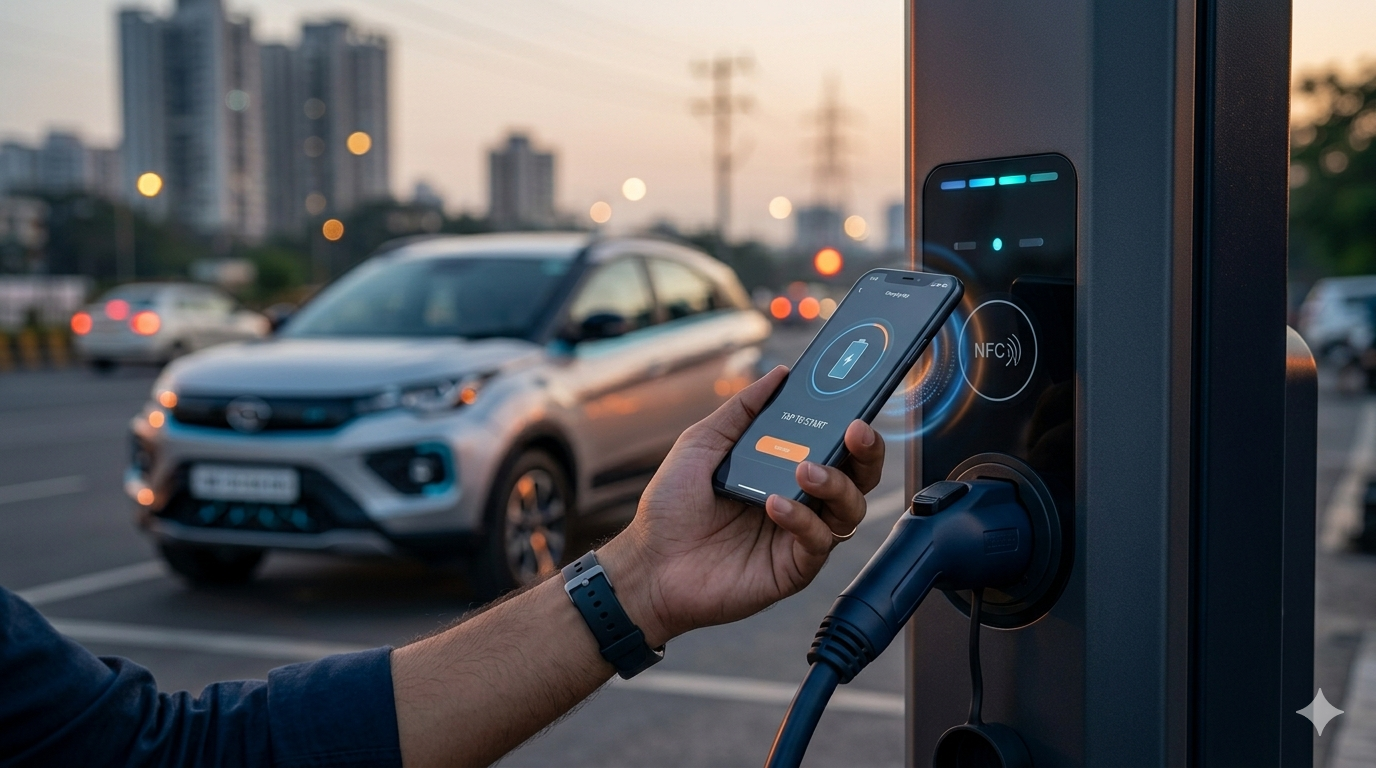
From the driver's perspective, OCPI roaming should be invisible: tap the same card or open the same app, and it works — regardless of which operator's charger you are standing in front of. The complexity is in the backend settlement between CPO and eMSP; the driver should never see it.
EVBooth's Position
EVBooth's CSMS platform supports OCPI 2.2.1 as both CPO and eMSP. We are working toward roaming exchange partnerships with other Indian networks, with the goal that any EVBooth app user can see and use partner network chargers alongside our own, and any partner network driver can use EVBooth chargers. Roaming is a market maturity signal — the networks that invest in it now will benefit as the driver base grows and interoperability becomes an expectation rather than a differentiator.