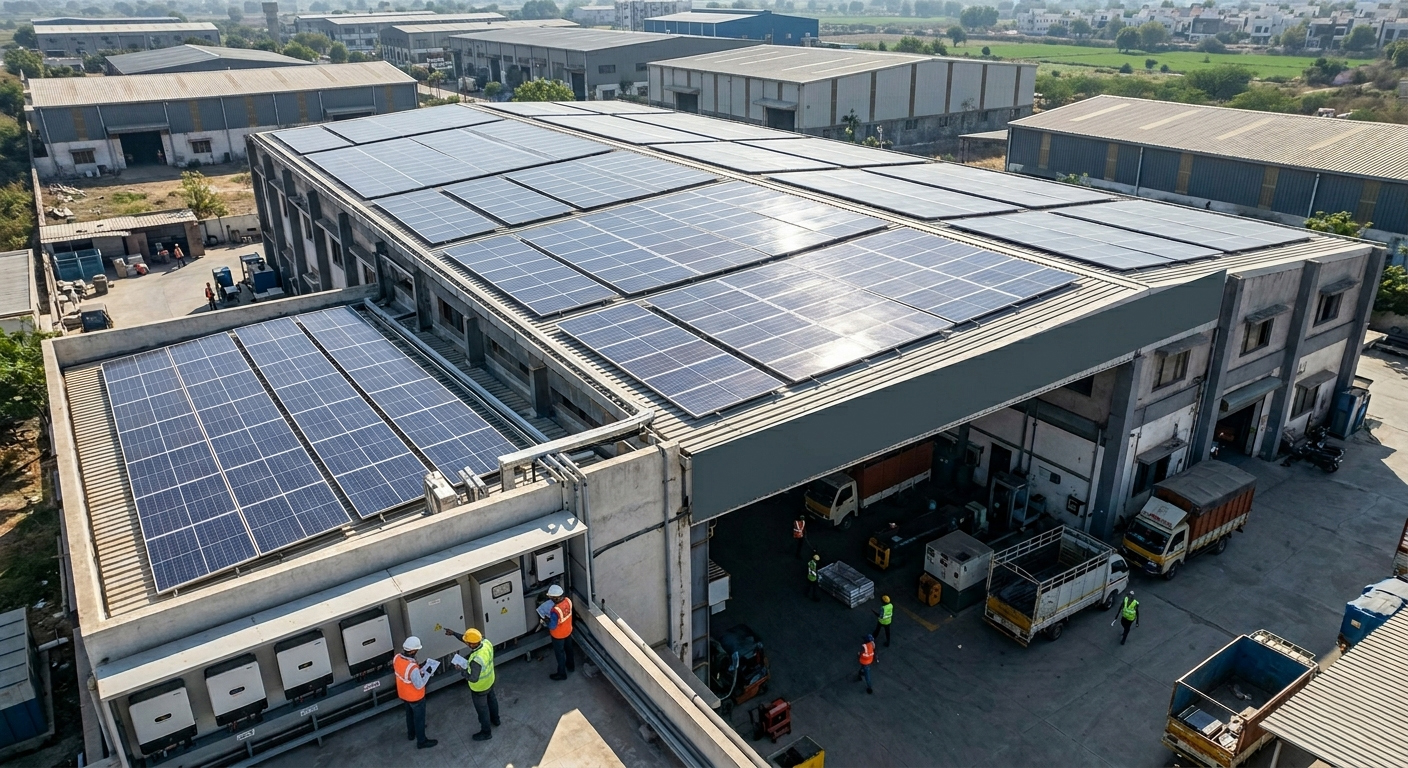
MSMEs Don't Get PM Surya Ghar — But They Still Win
Unlike residential consumers, MSME and industrial connections cannot use PM Surya Ghar Central Financial Assistance. The scheme is explicitly for households. But MSMEs have their own toolkit: state capital subsidies, 40% accelerated depreciation under the Income Tax Act, CGTMSE-backed collateral-free green loans, and rising grid tariffs that make solar economics compelling even without direct subsidy.
A well-designed MSME rooftop system in Gujarat, Karnataka, UP, or Haryana can achieve a 2.5–4 year payback, even without direct central CFA, once all financial benefits are combined.
State-Level Industrial Rooftop Solar Subsidies
| State | Scheme / Policy | Capital Subsidy | Notes |
|---|---|---|---|
| Karnataka | KREDL / MSME Policy 2020 | ~30% of capex | Strong SARAL index; textile, engineering MSMEs |
| Gujarat | Industrial Rooftop Solar Policy | ~20% of capex | Strong net-metering; Surya Gujarat bill credits |
| Rajasthan | Industrial Solar Scheme | ~25% for eligible units | Rajasthan RE Policy 2023 |
| Maharashtra | MSME Green Energy Scheme | ~15–20% | MAHADISCOM net-metering rules apply |
| Uttar Pradesh | ODOP + State Industrial Policy | ~15–20% | Combine with PMFME/PMEGP for agro units |
| Tamil Nadu | TANGEDCO Rooftop Policy | ~15% | Strong C&I adoption base |
| Telangana | T-SURE industrial programme | ~15–20% | Focus on IT parks and pharma |
| Haryana | HAREDA MSME Solar | ~20% | Large auto-component cluster in Gurugram, Faridabad |
| Punjab | PEDA + NABARD financing | None direct; concessional loans | Dairies and rice mills key beneficiaries |
The Tax Benefit Stack: 40% Accelerated Depreciation
Under Section 32 of the Income Tax Act, solar power plants qualify for 40% accelerated depreciation in the first year. For a profitable MSME in a 22–30% tax bracket, this creates an immediate effective subsidy of ₹8,800–₹12,000 per lakh of project cost in the first year alone. Over 5 years, combined with normal depreciation on the remaining book value, the cumulative tax benefit can reach 15–20% of project cost — effectively acting as a second subsidy layer that does not require any application or approval.
For MSMEs that pay income tax, the accelerated depreciation benefit is often more valuable than a state capital subsidy — because it is automatic, immediate, and does not involve bureaucratic delays.
CGTMSE and Collateral-Free Green Loans
The Credit Guarantee Fund Trust for Micro and Small Enterprises (CGTMSE) provides guarantees to banks for collateral-free loans up to ₹2 crore for eligible MSMEs. Many PSU and private banks — including SBI, Bank of Baroda, Indian Bank, and HDFC — now have dedicated green or clean-energy loan products that use CGTMSE guarantee support. This means an MSME without significant fixed assets can still access a rooftop solar loan without pledging property, at interest rates of 9–12% per annum, significantly improving solar economics versus equity-funded installation.
Sector-Specific Opportunities
Textile and engineering MSMEs in Gujarat and Karnataka face high three-phase tariffs (₹8–12/kWh) and have large flat roofs ideal for solar. A 100 kW rooftop system in Ahmedabad or Bengaluru generates roughly 1,40,000 units/year, replacing ₹11–16 lakh of grid electricity annually against an installation cost of ₹55–65 lakh — payback under 4 years even without subsidy.
Rice shellers and agro-processors in Punjab and Uttar Pradesh have predictable daytime loads aligned with solar generation peaks. The combination of NABARD refinancing for warehouse-scale projects and PEDA's solar loan schemes makes Punjab one of the most practical states for agro-MSME solar.
Hotels, resorts and restaurants in Goa can significantly cut cooling and water-heating loads with rooftop solar, and Goa's up to 30% capital subsidy (GEDA policy) makes the economics particularly attractive for the hospitality sector. Green credentials also serve as a marketing advantage in international tourist markets.
How to Build a Business Case for Your MSME
The five inputs that determine payback are: installed cost per kW (typically ₹55,000–₹70,000 for commercial-grade systems), your current grid tariff (check your electricity bill), your daytime load profile (percentage of consumption during 9am–4pm), available roof area, and applicable subsidies or tax benefits. Most DISCOMs and state RE agencies have online solar calculators — use them before committing to a vendor. Alternatively, request a Detailed Project Report (DPR) from two or three MNRE-empanelled vendors and compare their assumptions explicitly.