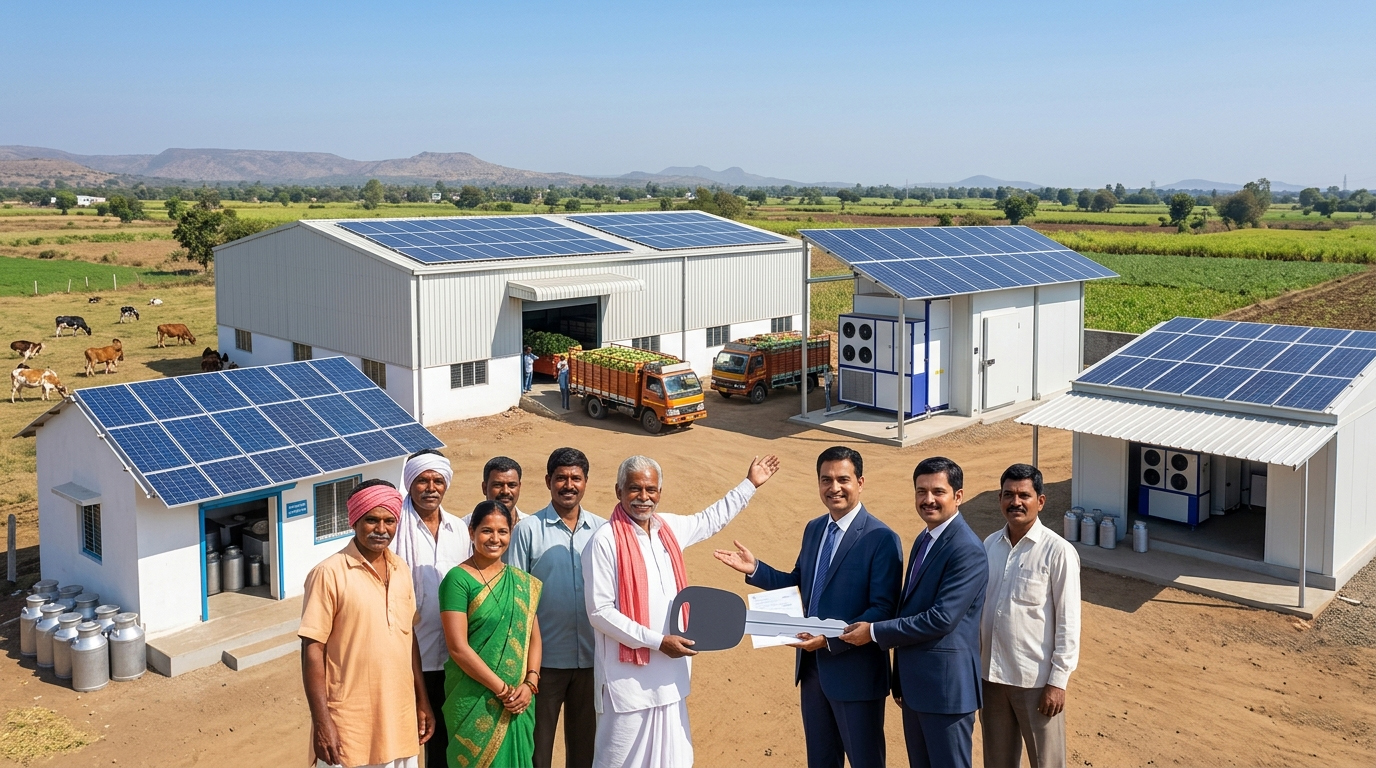
The New Rural Formula: Solar + Income + Layered Subsidies
India's most powerful rural solar opportunity is not residential rooftop — it is solar-powered enterprise. When a rural entrepreneur, SHG, or farmer producer organisation correctly combines PMEGP, PMFME, PM-KUSUM, and NABARD refinancing, the effective subsidy coverage on a new productive enterprise can reach 50–70% of total project cost — reducing the private investment required to a manageable 10–20% margin.
This article explains the four core schemes, how they interact, and provides real financial models for common rural enterprise types.
The Four Core Schemes
PMEGP (Prime Minister's Employment Generation Programme) is administered by KVIC under the Ministry of MSME. It provides 25–35% margin-money subsidy on bank-financed micro-enterprise projects. For rural SC/ST, OBC, women, minorities, persons with disabilities, and ex-servicemen, the subsidy is 35%. General category rural applicants receive 25%. Project cost can be up to ₹50 lakh for manufacturing and ₹20 lakh for service enterprises, and solar equipment cost can be included in the project DPR.
PMFME (PM Formalisation of Micro Food Enterprises) is a ₹10,000 crore scheme under MoFPI. It offers 35% capital subsidy (up to ₹10 lakh) for existing and new micro food-processing units, 50% grant for branding and marketing support, and ₹40,000 per SHG member for working capital. It operates on an ODOP (One District One Product) framework, meaning each district's nodal agency focuses on its designated product — rice, wheat, spices, fish, or another category — with priority subsidies for units working in those categories.
PM-KUSUM (Pradhan Mantri Kisan Urja Suraksha Evam Utthaan Mahabhiyan) covers three components — decentralised solar plants (A), standalone solar pumps (B), and solarisation of grid-connected pumps (C). For Component B standalone pumps up to 7.5 HP, the subsidy pattern is typically 60% state/central support, 30% bank loan, and 10% farmer contribution. The solar pump then enables reliable, free irrigation — which in turn supports the feedstock for downstream processing enterprises.
NABARD Refinance and AIF (Agriculture Infrastructure Fund) provides concessional refinancing to banks for rural infrastructure projects including warehouses, cold storages, processing centres, and dairy facilities. Interest subvention of 3% is available under AIF for projects up to ₹2 crore. When solar rooftop or ground-mounted systems are included as part of the project, the entire integrated project can be financed at concessional rates.
Financial Models: Four Rural Enterprise Examples
| Enterprise | Total Project Cost | Schemes Used | Total Subsidy | Loan Required | Estimated Payback |
|---|---|---|---|---|---|
| Solar Atta Chakki (3 kW + mill) | ₹12,00,000 | PMEGP 25% + PMFME 35% | ₹7,20,000 | ₹3,60,000 (10% own + balance) | 3–4 years |
| Solar Rice Mill (10 kW + equipment) | ₹40,00,000 | PMFME 35% (cap ₹10L) | ₹10,00,000 | ₹30,00,000 | 4–5 years |
| Solar Cold Storage (20 kW + cold room) | ₹1,00,00,000 | NABARD/AIF (3% interest sub) | No direct grant; ₹6L+ in interest savings | ₹80,00,000 | 5–6 years |
| Solar EV Charging Café (10 kW + fitout) | ₹50,00,000 | PMEGP 35% (services cap ₹20L) | ₹7,00,000 | ₹42,50,000 | 3–4 years |
The most important rule of scheme stacking: no single asset can receive subsidy from two schemes simultaneously. A solar panel cannot be both PMEGP-subsidised and PMFME-subsidised. The solution is to split the project DPR — solar and civil under PMEGP, processing machinery and equipment under PMFME.
Case Study: Solar Atta Chakki in Eastern Uttar Pradesh
A 28-year-old woman in Azamgarh district, belonging to OBC category, wants to set up a flour mill and solar plant in her village. Her total project cost is ₹12 lakh (3 kW solar: ₹2.1 lakh, mill and equipment: ₹6 lakh, building and civil: ₹3 lakh, working capital: ₹0.9 lakh). She applies to PMEGP through the KVIC district office with a 35% rural OBC subsidy — receiving ₹4.2 lakh in margin money. She then applies to PMFME for the milling and packaging equipment under the district's ODOP (wheat products), receiving 35% on eligible equipment cost of ₹5 lakh — an additional ₹1.75 lakh. Total subsidy: ₹5.95 lakh. Her own contribution is ₹0.6 lakh (5% of PMEGP portion) and she takes a ₹5.45 lakh bank loan for the balance. Monthly flour sales of 3 tonnes at ₹2/kg margin = ₹6,000/month revenue contribution, plus ₹2,800/month electricity savings from solar = ₹8,800/month surplus against a loan EMI of ₹6,200. Payback achieved in approximately 3.5 years.
Case Study: Solar Mini Rice Mill in Assam
An FPO (Farmer Producer Organisation) in Jorhat district of Assam wants to integrate paddy procurement, milling, and solar irrigation across 200 member farmers. The project has three inter-linked components: a PM-KUSUM Component C solar pump solarisation for paddy irrigation (60% subsidy, 30% loan, 10% farmer); a PMEGP-funded rice mill with solar rooftop (25% margin money); and a PMFME-funded de-husking and packaging unit for the FPO's branded rice (35% subsidy). The total system becomes largely self-funding through scheme coverage — and the FPO's brand can access PMFME's 50% marketing support for packaging and labelling.