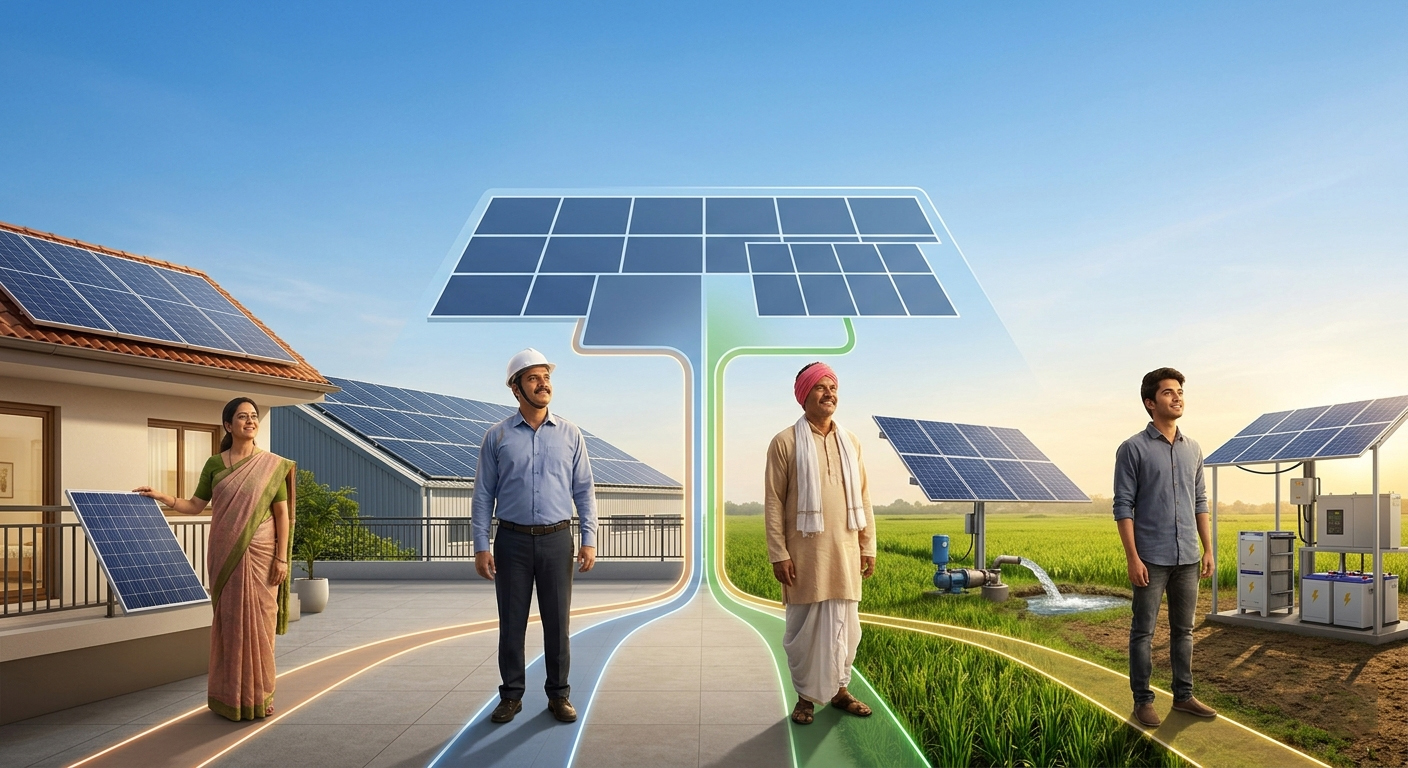
Four Journeys Through India's Solar Subsidy Landscape
India's solar subsidy ecosystem has four fundamentally different pathways depending on who you are. A homeowner, an MSME, a farmer, and a rural entrepreneur each access different schemes through different agencies with different documentation requirements and timelines. This guide maps out all four pathways clearly — so you can identify your route, shortlist the right schemes, and take the first concrete action today.
Pathway 1: The Homeowner
Best scheme: PM Surya Ghar via the National Portal for Rooftop Solar. You are a household electricity consumer. You own or rent your home with roof access. Your goal is to reduce your electricity bill and possibly earn from net-metering credits.
Action steps: Register on pmsuryaghar.gov.in with your consumer number. Check your state's top-up via your DISCOM or state RE agency website. Select only empanelled vendors (verified on the portal). Install, commission, upload documents, and receive DBT subsidy.
Priority states for homeowners: Odisha (₹1.38 lakh), Uttarakhand (₹1.43 lakh), Assam (₹1.23 lakh), Nagaland (₹1.36 lakh), Delhi (₹1.08 lakh), Uttar Pradesh (₹1.08 lakh). If you are in Gujarat, Karnataka, Maharashtra, or Tamil Nadu — no state top-up, but strong net-metering makes PM Surya Ghar still financially compelling with 4–6 year payback.
Pathway 2: The MSME or Business Owner
Best approach: State MSME capital subsidy + accelerated depreciation + CGTMSE-backed green loan. You own a factory, hotel, restaurant, hospital, or commercial building. You want to cut your electricity bill and potentially access green finance at lower rates.
Action steps: Identify your state's MSME capital subsidy for solar (Gujarat ~20%, Karnataka ~30%, Haryana ~20%). Get a project DPR from two empanelled vendors with full financial analysis including accelerated depreciation benefit. Apply for CGTMSE-backed green loan with your bank. Include solar cost in your GST input tax credit claims.
Priority sectors: Textile mills (Gujarat, TN), rice shellers (Punjab, UP), food processing (all states), hospitality (Goa, UK), auto-components (Haryana, UP), IT/data centres (Karnataka).
Do not let the absence of PM Surya Ghar eligibility discourage you. The combination of 40% accelerated depreciation, CGTMSE guarantee, and rising grid tariffs often makes MSME solar payback faster than residential, even without direct government grant.
Pathway 3: The Farmer or FPO
Best scheme: PM-KUSUM (Component B or C) + NABARD/AIF for downstream processing. You are a farmer, farming cooperative, or Farmer Producer Organisation. You want to reduce irrigation costs and potentially build income-generating enterprises around your farm.
Action steps: Apply to your state nodal agency for PM-KUSUM Component B (new solar pump) or Component C (solarise existing pump). Once solar pump is operational, build the case for AIF-financed cold storage or processing infrastructure that uses the reliable irrigation feedstock. Layer PMFME for any food processing equipment in the downstream enterprise.
Priority states for farmers: Rajasthan (PM-KUSUM leader), UP (sugarcane + wheat), Assam (paddy), Karnataka (horticulture + drip irrigation), Himachal (apple belt).
Pathway 4: The Rural Entrepreneur (Youth / Women / SHG)
Best combination: PMEGP + PMFME + Solar, with state-specific additions. You are a first-generation entrepreneur, an SHG member, or a young person in a rural or semi-urban area wanting to start a productive enterprise. You have limited capital but strong local market knowledge and a specific product or service in mind.
Action steps: Identify your district's ODOP product (check your state PMFME nodal agency's website). Design a DPR for a solar-powered food processing or service enterprise that aligns with the ODOP category. Apply to PMEGP through KVIC for the manufacturing/service enterprise (25–35% subsidy). Apply to PMFME for the food processing equipment (35% subsidy, up to ₹10 lakh). If your enterprise uses agricultural inputs, also explore PM-KUSUM for upstream irrigation support. Use MUDRA loan for working capital and daily operations.
High-potential enterprise types by state: Solar atta chakki (UP, MP, Rajasthan), solar rice mill (Assam, WB, Odisha), solar spice grinder (Gujarat, Karnataka, Kerala), solar fruit dryer (HP, UK), solar dairy (Punjab, UP, Maharashtra), solar EV charging café (Goa, Karnataka, UK hill circuits).
Your Next Three Actions
Whichever pathway applies to you, three actions will clarify your specific opportunity in the next 72 hours. First, identify your state's current subsidy rates on the National Portal (pmsuryaghar.gov.in for residential) or your state RE agency's website (for MSME and enterprise schemes). Second, shortlist two MNRE-empanelled vendors in your area and request a site-specific DPR with financial analysis including all applicable subsidies, tax benefits, and payback calculation. Third, contact your nearest KVIC district office (for PMEGP), state PMFME nodal agency (for food processing), or block-level agriculture office (for PM-KUSUM) to understand current open application windows and documentation requirements.
If you want EVBooth's perspective on combining solar with EV charging infrastructure — for hospitality, commercial buildings, or EV charging café enterprises — reach out to our team. The solar-EV integration model is one of the most compelling new business opportunities in India's energy transition, and we are actively partnering with entrepreneurs across Bengaluru, Guwahati, Lucknow, and emerging EV corridors nationwide.