PMFME in One Minute
The Prime Minister Formalisation of Micro Food Enterprises (PMFME) scheme is a ₹10,000 crore initiative running through 2025–26 to formalise 2,00,000 micro food-processing units across India. Its core financial benefit is a 35% capital subsidy up to ₹10 lakh per unit — disbursed as a credit-linked grant through banks. Additional benefits include 50% grant for branding and marketing support (up to ₹3 lakh), and ₹40,000 seed capital per SHG member for working capital.
The scheme operates on an ODOP (One District One Product) framework — each district has a designated agri-produce, and applications for enterprises working in that product get priority processing. This means your application approval speed and the availability of cluster support depends significantly on whether your planned product matches your district's ODOP designation.
Why Solar and Food Processing Are a Natural Fit
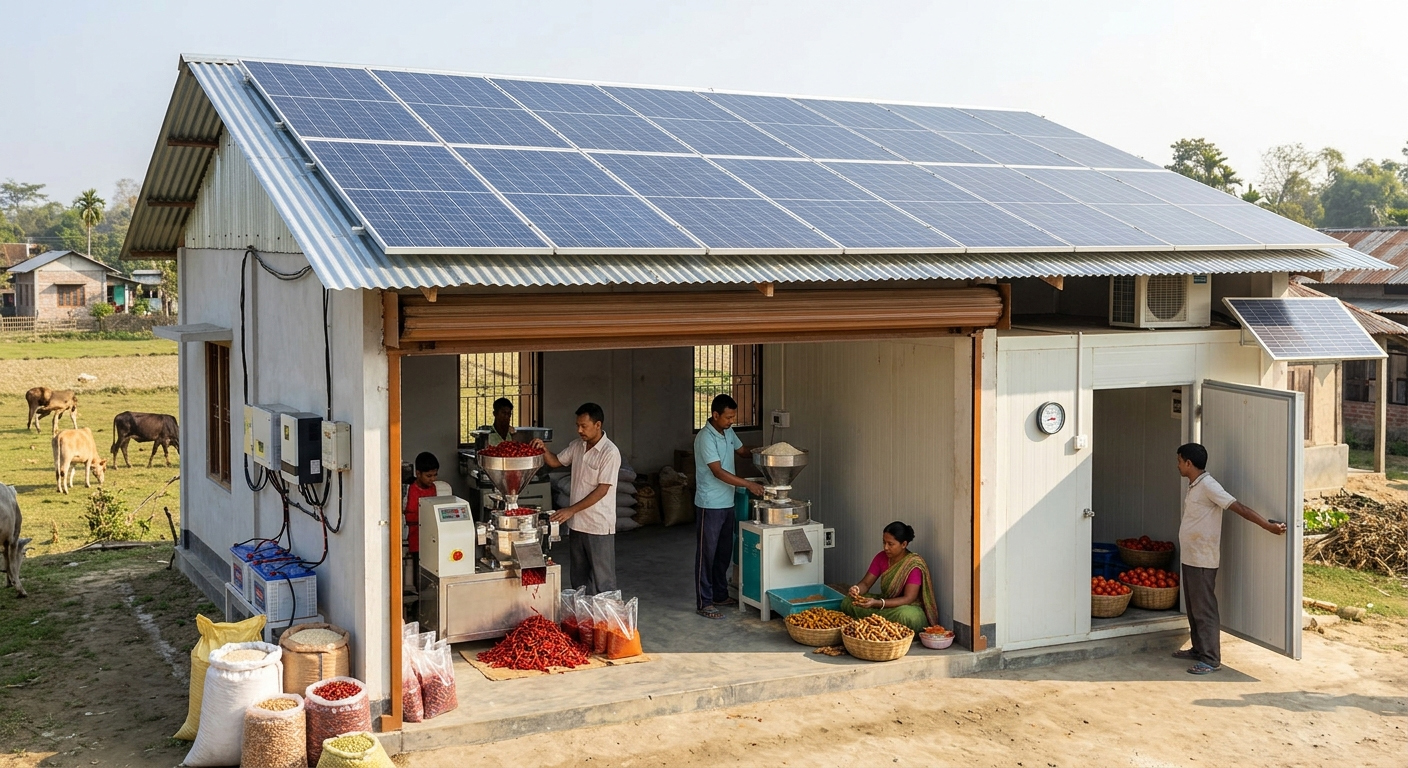
Energy is the second-largest operating cost for food processing units after raw material. A flour mill, rice de-husker, spice grinder, or oil expeller runs on electricity throughout the day — exactly when solar generation is at its peak. Solar rooftop on a PMFME-funded food processing unit typically reduces electricity costs by 60–80% for daytime operations, cutting the unit's monthly operating expense by ₹4,000–₹18,000 depending on size. This directly improves profitability and loan serviceability, which is why PMFME's nodal agencies are increasingly encouraging solar integration in new project DPRs.
State-Wise PMFME Opportunity Map
Gujarat leads PMFME implementation nationally with approximately 675 beneficiaries processed by mid-2025. Key ODOP products include groundnut oil, sesame, spices (Unjha belt), and khakhra. Solar-powered oil extraction and spice grinding units in Saurashtra, Kutch, and North Gujarat are particularly strong opportunities.
Uttar Pradesh has one of the richest ODOP lists in India — rice (Gorakhpur, Azamgarh), wheat/atta (entire western UP), pulses (Kanpur region), dairy (Mathura), spices (Rampur), and many more. PMFME units here benefit from UPNEDA's rooftop solar subsidy running concurrently, creating the possibility of overlapping but compliant subsidies (solar via PM Surya Ghar residential if the unit is home-based, or state MSME solar if commercial-registered).
Punjab offers rice mills, dairy units, and value-added dairy (lassi, paneer, ghee) as strong PMFME categories. PEDA and NABARD are active partners for parallel solar-and-cold-chain investment alongside PMFME processing equipment grants.
Assam has rice, tea, and mustard oil as ODOP anchors. Solar-powered mini rice mills and mustard oil expellers in Nagaon, Barpeta, Sonitpur, and Kamrup districts align strongly with PMFME focus areas. The Assam state top-up on residential solar (₹45,000 via APDCL) can further reduce costs if the processing unit operates from the homestead.
Himachal Pradesh focuses on apple, stone fruit, and herb processing — all of which have significant energy requirements for drying, grading, and cold storage. PMFME combined with horticulture department grants and NABARD's cold-chain financing creates a powerful package for apple-belt entrepreneurs in Shimla, Kinnaur, and Kullu.
Goa presents opportunity in cashew processing, fish curing and packaging, and coconut products. Solar drying significantly reduces spoilage in coastal humidity. GEDA's up to 30% capital subsidy on solar can be combined with PMFME for an integrated unit.
How to Include Solar in Your PMFME DPR
Solar equipment — panels, inverter, mounting structure — can be included under Plant and Machinery in the project DPR. The subsidy of 35% applies to the total eligible project cost including solar, up to the ₹10 lakh cap. Key documentation required: solar system quotation from an empanelled vendor, technical justification of system size (based on connected load calculation), and net-metering approval from the local DISCOM. The DPR reviewer at the state nodal agency will verify that solar is an integral operational requirement of the food processing unit, not a standalone commercial power plant.