PM-KUSUM: What It Is and Why It Matters
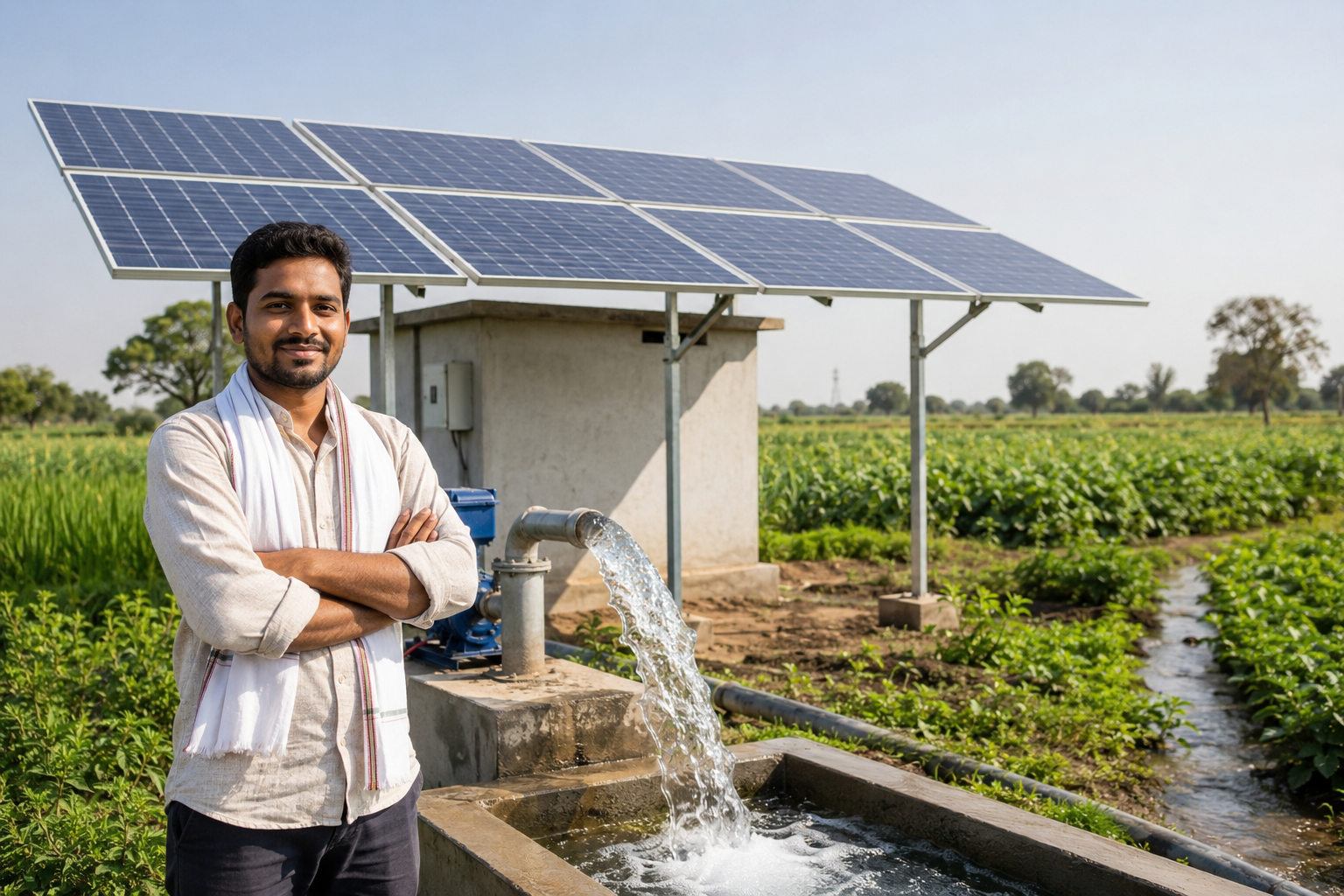
PM-KUSUM (Pradhan Mantri Kisan Urja Suraksha Evam Utthaan Mahabhiyan) is India's largest solar programme targeted specifically at farmers. Its target is to add 34,800 MW of solar capacity through three mechanisms: Component A (small decentralised solar plants on barren land), Component B (standalone solar pumps for irrigation), and Component C (solarisation of existing grid-connected agricultural pumps). The scheme runs with central and state government funding on a 30:30:30:10 or similar ratio, meaning farmers typically contribute only 10% of the cost while the rest is covered by government grants and bank loans.
Component-Wise Breakdown
| Component | What It Does | Typical Cost to Farmer | Government Support |
|---|---|---|---|
| A — Decentralised Solar Plants | 1–2 MW solar plants on barren/fallow farmland; power sold to DISCOM at fixed tariff | Farmer contributes land; developer handles capex | DISCOM buys power at ₹3.5–4.5/kWh for 25 years |
| B — Standalone Solar Pumps | New off-grid solar pumps (up to 7.5 HP) replacing diesel pumps | 10% of pump cost | 30% central + 30% state = 60% subsidy + 30% bank loan |
| C — Grid-Connected Pump Solarisation | Solarising existing agricultural connections; excess power exported to grid | 10% of system cost | 30% central + 30% state + 30% loan |
State-Wise PM-KUSUM Performance
Rajasthan has been the national leader in PM-KUSUM implementation, having achieved over 3,000 MW under Components A and C. The state's desert terrain and high solar irradiation (6+ peak sun hours/day) make it the most financially productive state for Component A land-lease solar plants. Farmers with barren land near existing sub-stations receive ₹25,000–₹35,000 per acre per year from DISCOMs under 25-year PPAs.
Uttar Pradesh has massive agricultural load — the state subsidises power heavily for farmers, creating a strong economic case for replacing subsidy-dependent grid connections with self-sufficient solar pumps. UP's sugarcane, wheat, and rice belts all benefit significantly from reliable solar irrigation.
Assam is using PM-KUSUM to stabilise paddy irrigation in areas where monsoon variability and flooding create unpredictable water availability. Solar pumps provide supplementary irrigation during dry spells, directly reducing crop losses in Nagaon, Kamrup, and Jorhat districts.
Karnataka is a top performer on MNRE's SARAL renewable energy readiness index and has strong PM-KUSUM adoption particularly for drip-irrigation-integrated solar pump schemes in Vijayapura, Belagavi, and Chitradurga districts.
Himachal Pradesh is deploying smaller-capacity pumps (1–3 HP) suitable for hilly terrain, supporting horticulture irrigation for apple, pear, and vegetable growers in altitude districts where grid connections are expensive and unreliable.
The transformative potential of PM-KUSUM is not in the solar pump itself — it is in what the pump enables. Reliable, low-cost irrigation transforms one-crop dryland farmers into two-crop or three-crop producers, unlocking the feedstock for the PMFME and PMEGP processing enterprises described in other articles in this series.
From Solar Pump to Solar Enterprise
A PM-KUSUM solar pump in Uttar Pradesh's wheat belt enables a farmer to grow an additional rabi crop of mustard, generating raw material for a PMFME-subsidised mustard-oil unit. A solar pump in Assam's Brahmaputra floodplain enables a second paddy crop, creating year-round feedstock for a PMEGP-funded rice mill. A solar pump in Himachal's apple belt enables micro-irrigation of fruit trees, increasing yield quantity and quality, which justifies PMFME-funded apple processing and drying infrastructure. In Karnataka, PM-KUSUM solar pump solarisation of existing connections leaves excess energy available for dairy chilling, enabling NABARD-funded bulk milk cooler installation at village level.
How to Apply for PM-KUSUM Component B
Applications are submitted to the state nodal agencies — UPNEDA in UP, ANEDA in Assam, KREDL in Karnataka, HIMURJA in Himachal. Required documents include land ownership records (7/12 extract or equivalent), Aadhaar, latest electricity bill (for existing connection holders in Component C), and bank account details. State agencies typically run application windows aligned with annual MNRE allocations — check the state agency website and PM-KUSUM portal (mnre.gov.in) for current open windows.